











Workforce strain, digital capability and resilience in adult social care
4 minute read
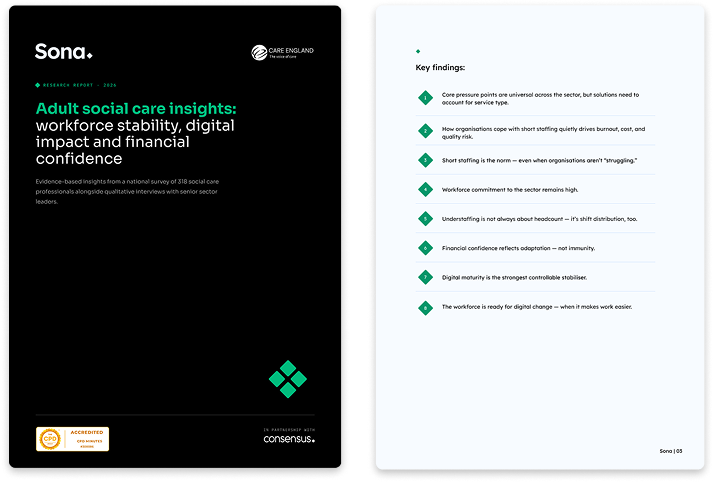
Adult social care is no stranger to pressure. Workforce shortages, rising costs, increasing acuity and operational complexity are no longer temporary challenges; they are now the day-to-day reality for providers across residential, supported living and domiciliary care. A recent Care England webinar, drawing on findings from the Sona report on workforce strain, digital capability and resilience, explored what the latest evidence tells us about how services are coping, and why “coping” may no longer be enough.
The problem: short staffing as the new normal
The research paints a picture many providers will recognise. Short staffing is no longer episodic; it is a baseline operating condition for a significant proportion of services. Crucially, this is not just about vacancies. Homes and services can appear “fully staffed” on paper yet remain operationally fragile because rotas do not align with fluctuating acuity, peaks and troughs of demand, and the complexity of care being delivered.
As a result, services rely heavily on overtime, informal cover and workarounds. While agency use may be lower than during the pandemic, the pressure has not disappeared – it has shifted elsewhere.
The system itself is designed with a very small level of slack. Once pressure increases in one or two areas, there’s only so far the staff can really go.
Richard Ayres, Social Care Advisor for Care England
What the evidence shows: goodwill masking fragility
One of the most uncomfortable findings from the research is that workforce commitment remains high. Many staff intend to stay with their employer, and loyalty to residents and colleagues remains strong. On the surface, this looks positive. In practice, it risks masking fragility in the operating model. Where resilience depends on goodwill, overtime and informal stretching, the system is not resilient; it is deferring risk.
Burnout concerns, difficulties retaining staff and the normalisation of “making it work” are warning signs. Missed breaks, uncovered shifts and repeated reliance on the same individuals to fill gaps are leading indicators of strain that are often invisible in headline metrics such as vacancy rates.
Funding and commissioning realities
The research is clear that this is not about individual providers failing. Many providers are operating within a commissioning and funding model that does not reflect today’s realities of acuity and demand. Commissioned hours do not always align with what is needed to deliver safe care. Providers frequently absorb the gap, accepting placements below the cost of delivery to avoid empty capacity and to keep services viable. Over time, this thins margins and limits the ability to invest in workforce, training and systems.
A recurring theme from the webinar discussion was the lack of operational visibility to evidence these pressures in conversations with commissioners. Without credible, granular data on what is happening day-to-day, it is difficult to bridge the gap between what providers know to be true and what systems can fund.
Digital capability: infrastructure, not an add-on
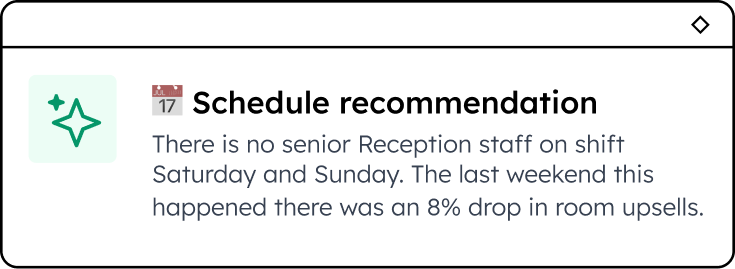
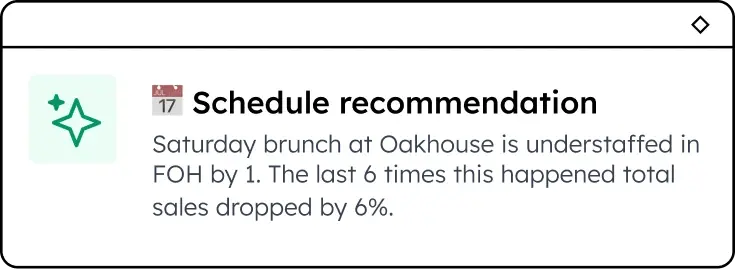
One of the strongest findings in the report is the role of digital capability as a stabilising lever that providers can influence. Digital maturity is not about technology for its own sake. It is about operational visibility: understanding where strain is building, where rotas are fragile, and where cost and deployment patterns are diverging from plan.
Where digital systems capture what was planned versus what actually happened, leaders can surface leading indicators of risk earlier, before issues appear in retention figures or quality concerns. Over time, better visibility supports more credible conversations with commissioners about what safe care actually costs to deliver.
We should think of digital as core infrastructure, rather than something that gets layered on afterwards. It should be a foundation that everything else grows from.
Ben Dixon, Sona's CTO
From insight to action: what providers can do now
The webinar closed with practical starting points that do not rely on system-wide reform:
1. Track invisible strain, not just vacancies.
Look beyond vacancy rates to overtime patterns, uncovered shifts, missed breaks and repeated reliance on goodwill. These are early warning signs of fragility.
2. Test whether rotas reflect real acuity and demand.
Regularly review whether staffing patterns match peaks in need, not just commissioned hours. Small mismatches can create disproportionate pressure on teams.
3. Use workforce and deployment data in commissioning conversations.
Build an evidence base to support discussions about funding and sustainability. Data that shows the gap between planned and actual delivery strengthens the case for realistic commissioning.
4. Treat digital capability as enabling infrastructure.
Prioritise systems that improve real-time visibility and learning, rather than adding layers of retrospective reporting. The aim is to design out pressure, not ask people to absorb it.
5. Design for sustainability, not perpetual coping.
Ask where your organisation is “coping” rather than structurally designed for today’s pressures. Identify one fragile area and test a small change.
A shared challenge
The research doesn't tell us that adult social care is broken, it tells us that the sector is resilient, but too much of that resilience is being carried by people.
Richard Ayres, Social Care Advisor for Care England
The challenge now is to shift from coping to designing services that can operate safely and sustainably in the reality providers face today. If the evidence helps move one conversation from “we’re managing” to “is our model sustainable?”, it is already doing important work.
👉 Download the full report here.
➡️ Want to see what Sona can do for your operations? Let’s get some time in the diary to chat about your 2026 goals and see where tech can make a difference.
Enjoyed this article? Let's stay in touch 👋
If you liked this article, why not subscribe to our newsletter to get the latest news and views delivered straight to your inbox?