






Why fixing everyday friction is now the real productivity opportunity
4 minute read
If there was one theme that cut through our recent webinar discussion, it was this: the Hospitality industry doesn’t have a people problem—it has a systems problem.
Across the sector, teams are losing time, patience, and motivation because of outdated, disconnected, or inefficient processes. And while the conversation often focuses on guest experience, the reality is that your customer experience will never exceed your employee experience.
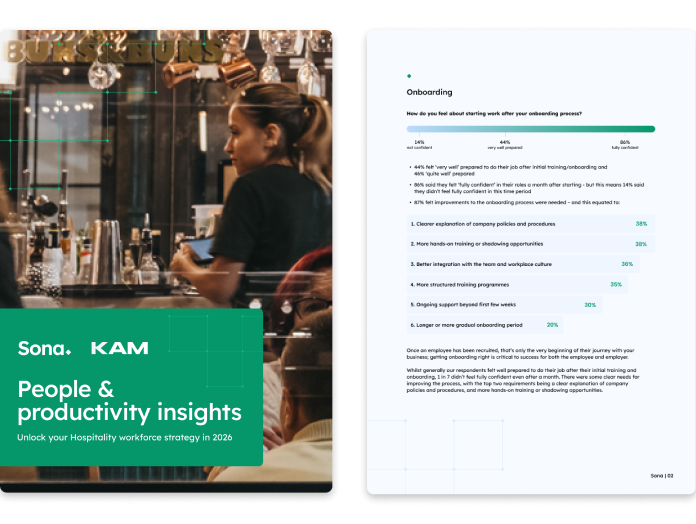
Katy Moses from KAM mentioned: “Every person in the UK that works in the Hospitality industry loses on average 1.2 hours a week through inefficient systems.” (insight from our recent People and Productivity report).
That’s an impactful number. Across a business of even modest scale, it adds up to hundreds—if not thousands—of hours wasted every year. Hours that could have been spent serving guests, developing teams, or improving operations.
And yet, this loss is often invisible because friction has become normalised.
The hidden cost of inefficiency
Tech for tech’s sake is pointless. It should either improve customer experience or free up our team for better customer service.
Katy Moses, Founder & Managing Director at KAM
This is the heart of the issue. Technology isn’t the problem. The wrong technology—or poorly implemented systems—is. When processes are slow, confusing, or duplicative, productivity drops, frustration grows, and your people spend more time wrestling with admin than interacting with guests.
Research shared during the webinar also revealed:
- Employees lose 1.2 hours per week due to inefficient systems
- 2% of employees say poor customer experience stems directly from tech issues
- Friction in the employee journey directly impacts service quality, retention, and morale
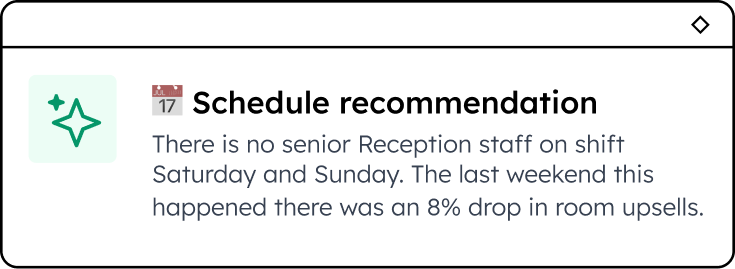
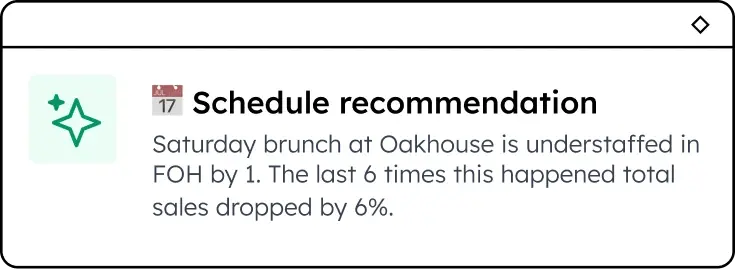
These aren’t abstract numbers. They show up in rota confusion, onboarding delays, chaotic communication, and constant firefighting.
What Nightcap learned by looking closely at the employee journey
One of the most compelling perspectives came from Kim Handy, Head of People at Nightcap, who stressed the importance of reviewing the employee experience with the same care as the guest experience:
There are so many points in our employee journey in Hospitality where things are slow, frustrating, or cause confusion.
Kim Handy, Head of People at Nightcap
Kim highlighted that these friction points—whether in onboarding, rota communication, training, or accessing basic information—chip away at productivity and team morale.
The message was clear: If the employee journey is fragmented, so is everything else.
Tailoring communication and reducing friction
One theme that resonated strongly across the panel: teams perform better when communication is transparent, consistent, and tailored to the individual.
Hospitality teams are diverse, multi-lingual, and multi-generational. A one-size-fits-all approach to communication simply doesn’t work anymore.
Giving employees visibility over schedules, expectations, development pathways, and company updates helps build trust—something Hospitality struggles to maintain at scale.
When you remove unnecessary friction, something powerful happens: employees stop firefighting and start excelling.
Providing clear frameworks, simple tools, and supportive systems allows teams to focus on the parts of the job that matter—delivering great experiences and taking pride in their work.
Empowerment isn’t a buzzword; it’s a design principle
Leadership’s role: Set the tone, remove obstacles
Leadership in Hospitality often means being pulled in a hundred different directions. But as the panel highlighted, leaders have enormous influence over engagement by:
- Setting expectations
- Reducing systemic friction
- Modelling communication
- Ensuring systems actually work for frontline teams
When leaders invest in solving operational friction, engagement rises naturally.
Key takeaways
If productivity and engagement are priorities (and they should be), here’s where to start:
✔️ Streamline systems
Audit your processes. Remove duplication. Ensure tech tools genuinely help.
✔️ Address friction points early
Map the employee journey—from application to exit—and fix the spots where time, motivation, or clarity are lost.
✔️ Listen to your teams
Find out what actually slows them down. Their answers will surprise you.
✔️ Tailor communication
Meet people where they are. Use channels and formats that work for them.
✔️ Empower employees with clarity
Transparency isn’t a luxury; it’s productivity infrastructure.
➡️ Want to find out more? Watch the full webinar on demand here.
Enjoyed this article? Let's stay in touch 👋
If you liked this article, why not subscribe to our newsletter to get the latest news and views delivered straight to your inbox?